.svg)



EN
EN

It’s your money but you can’t use it because it’s not in your account. We tackle your unpaid invoices without you losing your clients.


.svg)
.avif)
Want to increase your financial capacity to invest and grow? We make sure payments come in on time, so you can focus on your core business.
How do we do that?

Our trained cash flow specialists ensure timely and consistent reminders. As a result, payments remain top of mind with your clients and your money comes in faster.
.avif)
We collect outstanding invoices and ensure that the bond of trust with your client remains intact - also in the long term.
How do we do that?
No ruthless collection practices; we approach your clients in your name in a respectful and solution-oriented manner.
.avif)
Prevention is better than cure. We not only ensure that overdue invoices are paid, but also help you avoid new defaulters.
How do we do that?
Based on 20 years of expertise and 2.4 million records, we use artificial intelligence to predict which clients will become bad payers.
Do you understand all the financial terms? That’s great. For everyone else, we provide a glossary - to make sure we’re all on the same page.
The process of following up and collecting payment of outstanding invoices. Our speciality. Or as we call it: getting your money back without the hassle.
The financial risks a company faces due to the fact that clients may not pay their invoices (on time). With eXago at your side, those risks are not a surprise, but a manageable factor.
Resolving disputes over invoices, for example, due to incorrect amounts or disputed deliveries.

We know it might sound ‘too good to be true’, so we don’t expect you to simply take our word for it. Check out our client testimonials.
.svg)

Don’t immediately start to panic. First, calculate it. In one minute, our calculator shows you how much money is really tied up in outstanding invoices. Simple, quick and, in some cases, painfully honest. But it is the first step towards getting a better grip on your cash flow.
Herlinde Vermeulen
Accounting, DC RESOURCES

Hilde Van Wassenhove
Owner D&D Isoltechnics
Raf De Strooper
Finance manager, FLEXPOINT
Bart Wijckmans
Managing Director, WIJCKMANS NV
Guy Roefs
Finance & Administration Manager, SUEZ
Anouk Reekmans
Business Support Controller, Carglass
Sara Sterkmans
Accountant, VVSnv

One of your customers is not paying their bills and is in bad financial condition due to the ongoing coronavirus crisis. You are therefore considering having his goods seized quickly. However, does that make sense and, by the way, won't there be a new 'ceasefire' for bankruptcies anyway?
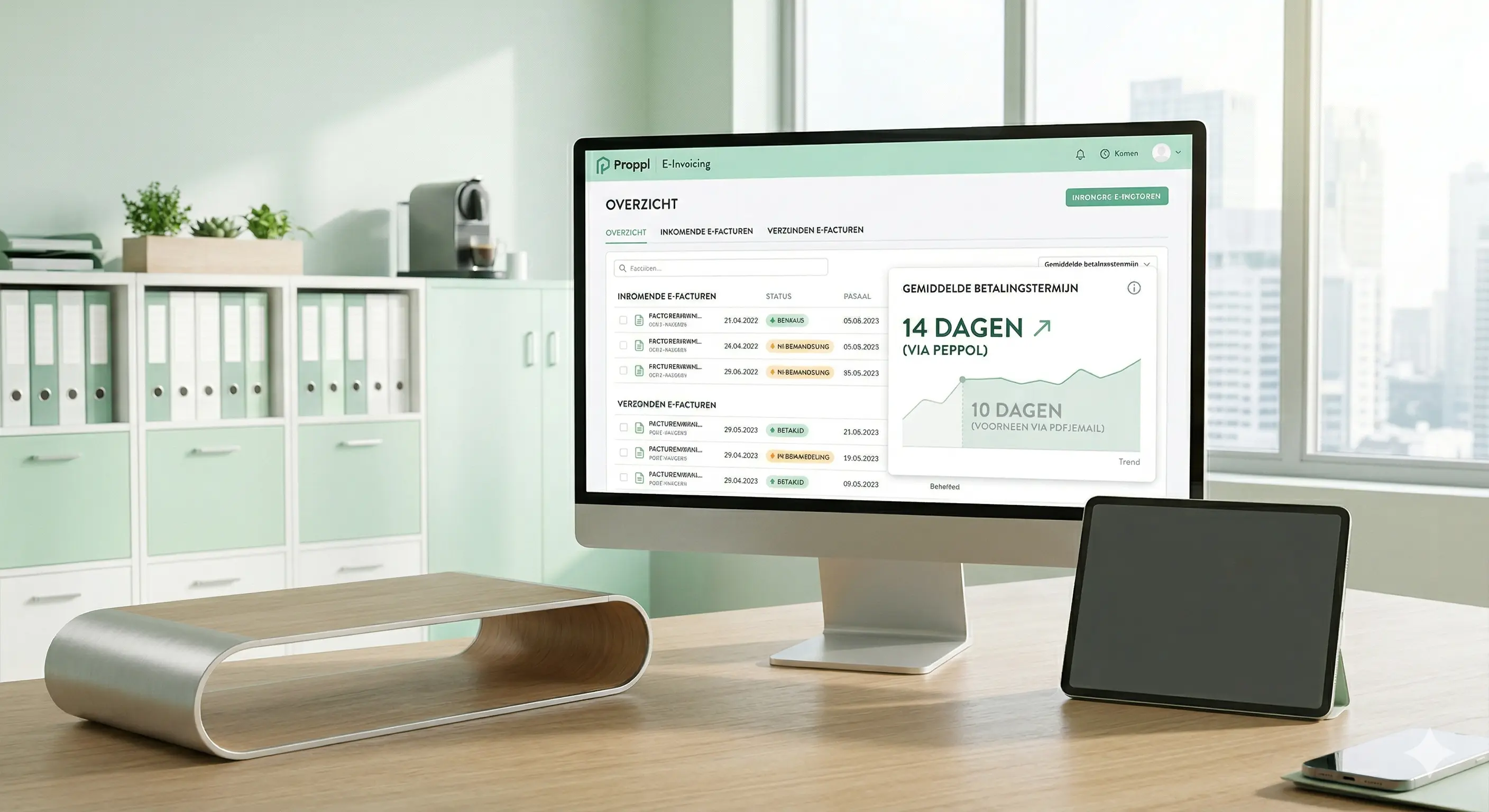
Invoices to other companies may no longer be sent in paper form or as a PDF by e-mail. So they no longer end up in the mailbox. As a result, e-invoices are remarkably often paid late. The period is up to 14 days, compared to 10 days by email.
Every company, no matter how small, is now required to invoice other companies via the Peppol network. Electronic invoicing has been mandatory in Belgium since 1 January for all transactions between companies. This administration must go through the Peppol network, a secure network for exchanging electronic documents. But you must avoid that invoices' disappear 'in a digital mailbox. That's where things are difficult today.

You placed an order with a supplier, but suddenly you hear that it has gone bankrupt. What now? Does that automatically mean that your order will no longer be delivered? And what if your supplier requests a judicial reorganization? In this blog post, we'll discuss the steps you can take and the rights you have in such situations.
The fact that you’re here is both good and bad news. Bad, because you have outstanding invoices of which, deep down, you’ve had enough. Good, because we can help you. How? You’ll find out in our demo. No sales pitches, just a no-nonsense explanation of how we can restore the health of your cash flow.
Nearly fell off your chair scrolling through our website and missed the demo buttons? No worries. Send us your question using the form and we’ll get back to you as soon as possible.


.svg)
.svg)